4G still connects phone calls about as fast as 5G, and often faster. Light Reading reports Ookla data showing that VoLTE vs VoNR is a contest of tuning, not technology generation. For travelers, the result says that the network you land on matters more than the "5G" badge on your screen.
What the Ookla tests measured
Ookla's RootMetrics unit measured call setup time, the delay between pressing call and hearing a ringtone. Voice over LTE (VoLTE) runs calls on 4G. Voice over New Radio (VoNR) runs them on 5G standalone (5G SA) cores. Ookla's research article by Luke Kehoe, dated October 4, 2026, covers Seoul, London, Malaysia, New York, Singapore, Lisbon and Luanda in the second half of 2025, plus Manila in the first half of 2026.
A delay under two seconds feels instant, according to the same article. Delays beyond four to five seconds make users doubt the call went through.
VoLTE vs VoNR: the numbers
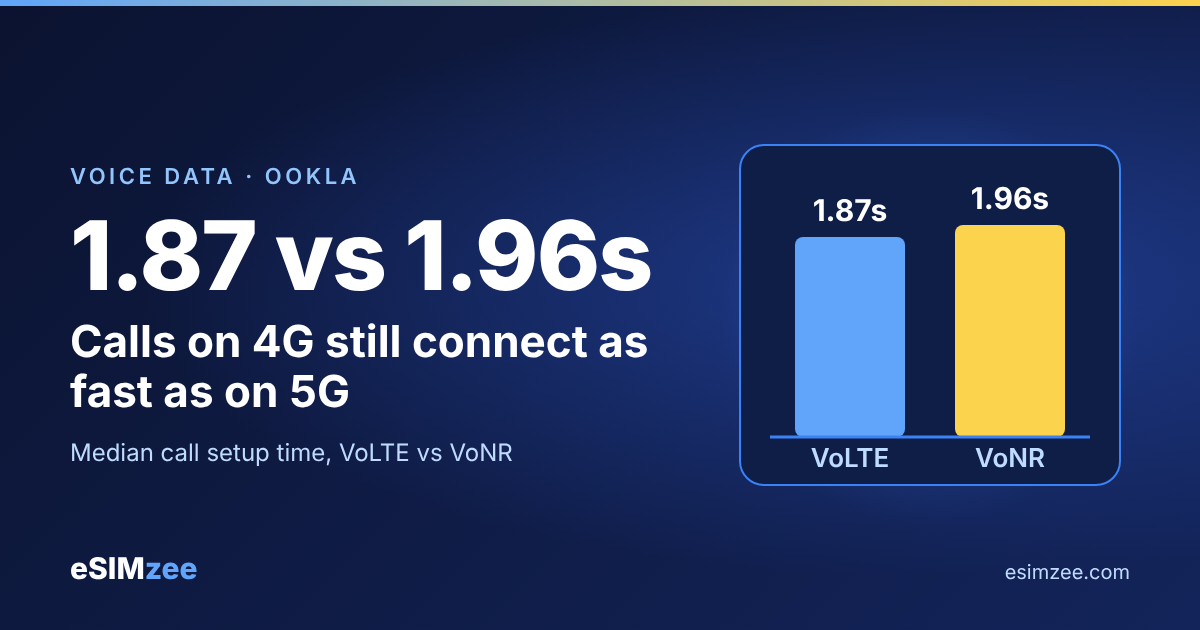
Globally, VoNR posts a median setup time of 1.96 seconds against 1.87 seconds for VoLTE, per Ookla. Ookla calls the roughly 5% gap comparable within the limits of the study.
The best results sit on the older technology. Korean operators in Seoul lead with a 1.06-second median on VoLTE, faster than any VoNR deployment studied, and over 90% of their calls meet the two-second target. LG U+ posts a 0.73-second median and SK Telecom 0.99 seconds.
Across eight operators, only six connected calls faster on VoNR than on VoLTE. Two showed the opposite:
- Singapore's StarHub ran VoNR 32% slower than its VoLTE, with a 95th percentile of 6.33 seconds.
- Korea's KT ran VoNR 13% slower than its VoLTE.
Two operators prove 5G voice can win. Singtel's VoNR median of 1.07 seconds beats its own VoLTE median of 1.22 seconds. Malaysia's YES posts a 1.6-second VoNR median against 2.17 seconds on VoLTE, about 26% faster.
Why most calls still ride 4G
Kehoe told Light Reading that even in markets that rolled out 5G standalone aggressively, many calls still drop back to LTE. He added that operators initially found VoNR performance "subpar relative to VoLTE." Light Reading attributes the gap to a decade of VoLTE refinement and the slow rollout of 5G SA cores.
Ookla also quantifies the penalty for falling back to 3G. Circuit-switched fallback (CSFB) has a global median setup time of 4.48 seconds, 2.4 times slower than VoLTE, and 5.5% of those calls take more than 10 seconds. Luanda is the market where this failure mode still dominates.
Carrier gaps travelers can see
Ookla finds sharp differences between operators on the same technology. EE and Three UK post VoLTE medians around 1.4 seconds and complete over 93% of calls within two seconds. Vodafone UK, AT&T and T-Mobile in the US sit closer to 2.3 seconds, with roughly 30-35% of calls inside the two-second mark.
Maturity varies by country too. Ookla cites GSMA Intelligence data putting VoLTE at roughly 93% of UK connections in 2025. The Philippines reached an estimated 31% that year, up from 14% in 2023, and GSMA Intelligence forecasts it to exceed 43% in 2026. Globe Telecom still delivered a 1.65-second median in Manila.
Voice use is shrinking where it is measured. Ofcom data cited by Light Reading shows UK mobile-originated call minutes fell 4.6% to 36.84 billion in the first quarter, year on year. Kehoe's verdict: "Voice is very seldom spoken about in the industry," yet it must simply work.
What this means for travelers
Pick your connectivity by local network quality, not by generation labels. A data-only eSIM sends calls through apps such as WhatsApp or FaceTime, which Light Reading says users already turn to when native calls connect slowly. Compare the local networks behind each plan on our eSIM provider comparison before you fly.
If you need a local number for bookings or deliveries, choose a plan on a carrier with a mature VoLTE footprint. Expect faster, steadier call connection in Seoul, London or Singapore than in markets still moving off 3G fallback.
Sources
- 4G is better than 5G for voice calls in most places — Light Reading, Michelle Donegan, October 12, 2026
- The 5G Voice Paradox: Why VoNR Isn't Always Better (Yet) — Ookla Research, Luke Kehoe, October 4, 2026