Travel eSIM is growing faster than operator roaming, and non-telco providers are driving it. A GSMA Intelligence presentation from March 2026 puts numbers on the shift, and those numbers show where travelers are buying.
Travelers want eSIM, and they know it exists
GSMA Intelligence reports that consumer awareness of eSIM rose from 25% in 2021 to 60% in 2025. Interest in using eSIM stands at 54%.
Travelers sit well above that average. Across 11 countries, 71% of travelers are aware of eSIM and 70% are interested in it, according to GSMA Intelligence's August 2025 consumer survey. The surveyed countries are Australia, France, Germany, Italy, Japan, Poland, South Korea, Spain, the UAE, the UK and the US.
Non-telco providers grow fastest
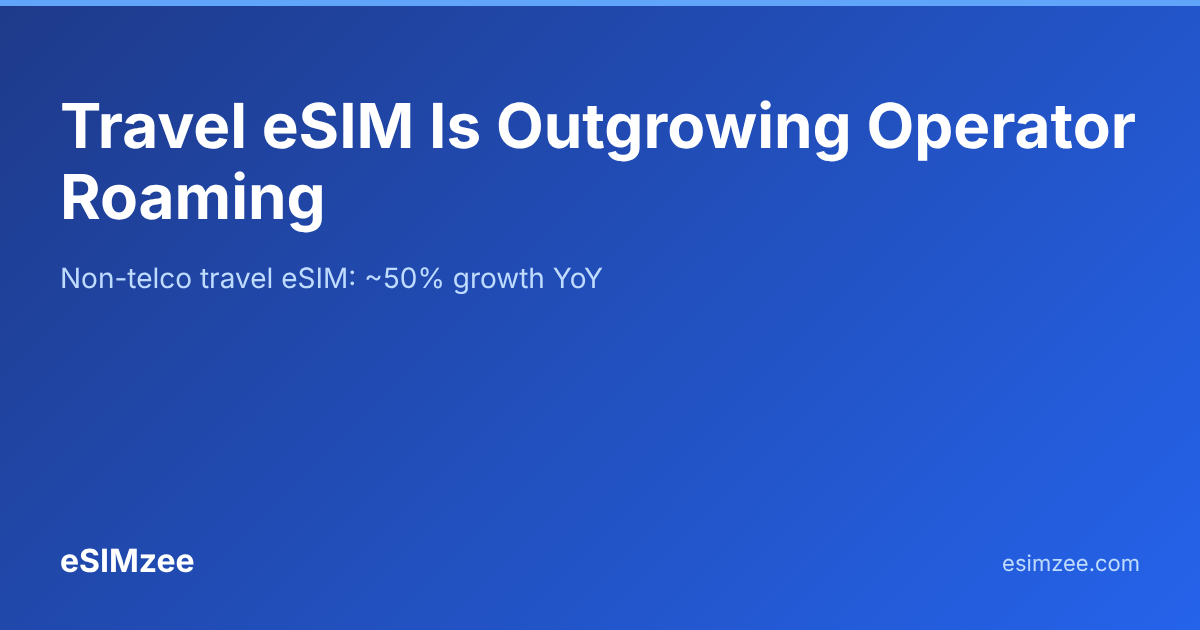
The survey separates travelers by where they get their eSIM. GSMA Intelligence finds 10% of travelers use eSIM from operators, with growth of about 15% year on year. Another 4% use eSIM from non-telco companies that sell global travel plans, and that group grows at about 50% year on year.
The report names Airalo and Holafly as the top two global travel eSIM providers, for whom roaming is the core business. It lists Nomad and Ubigi among the others.
Operators, fintechs and airlines enter the race
Competition is widening. GSMA Intelligence says operators compete through global travel eSIM offers, and it names Vodafone, Orange and Telefónica, or through enhanced traditional roaming offers.
Vertical companies are joining too. The report cites fintech firms such as Revolut, plus airlines, and describes their roaming products as a customer loyalty play rather than a core business.
Investors have noticed. GSMA Intelligence states that since 2022, eSIM has captured deals worth almost $700 million, and that 2025 was the strongest year ever, driven by travel eSIM and Internet of Things (IoT) deals.
Two late-2025 milestones set the stage
GSMA Intelligence points to September 2025, when Apple launched eSIM-only smartphones worldwide with the new iPhone Air. Apple also expanded its list of eSIM-only countries to 12 markets, mostly in Northern America and the Middle East.
In October 2025, China's three leading mobile operators launched commercial trials of eSIM smartphone services after receiving regulatory approval. GSMA Intelligence calls both events important catalysts for consumer adoption.
IoT eSIM is moving too
The presentation also tracks the GSMA SGP.32 specification, the eSIM standard for IoT devices. In a December 2025 operator survey, 39% of respondents had launched initial services or were testing them, 60% were considering plans and 1% had no plans.
Larger operators lead. GSMA Intelligence says 56% of them have either launched or are testing IoT services built on SGP.32.
The operator push is still unfinished
- 73% of mobile network operators (MNOs) have launched a domestic eSIM service for smartphones, as of December 2025.
- Only 8% of eSIM-aware consumers discovered eSIM through their MNO.
- 29% of consumers say they are happy with a removable SIM, 12% see no benefit in eSIM, and 11% do not understand how it works.
GSMA Intelligence forecasts that eSIM will reach 10% of global smartphone connections in 2026, and that eSIM will surpass the removable SIM by 2030. Its ranking of factors that could speed adoption includes a significant acceleration in travel eSIM adoption in third place.
What this means for travelers
The data points to a crowded, fast-moving market. Your home operator, a global travel eSIM provider and even your bank may all offer a plan for the same trip.
Compare them on price, data allowance and coverage before you fly. Compare eSIM providers on eSIMzee to see the options side by side.
Check that your phone supports eSIM first. GSMA Intelligence notes that 11% of consumers do not understand how eSIM works, and a plan bought for an unsupported device is wasted.
Sources
- eSIM: the time is right to push adoption, GSMA Intelligence (Pablo Iacopino), March 2026