AI agents in telecom are moving from network back-rooms to the customer queue. On October 6, 2026, NVIDIA reported that 89% of operators surveyed rate open-source AI as important to their strategy, and on October 14 Telus Digital became a deployment partner for Parloa's customer-service agents. Both moves point at the same place: the support chat you open when your eSIM will not connect.
Operators back open models for AI agents
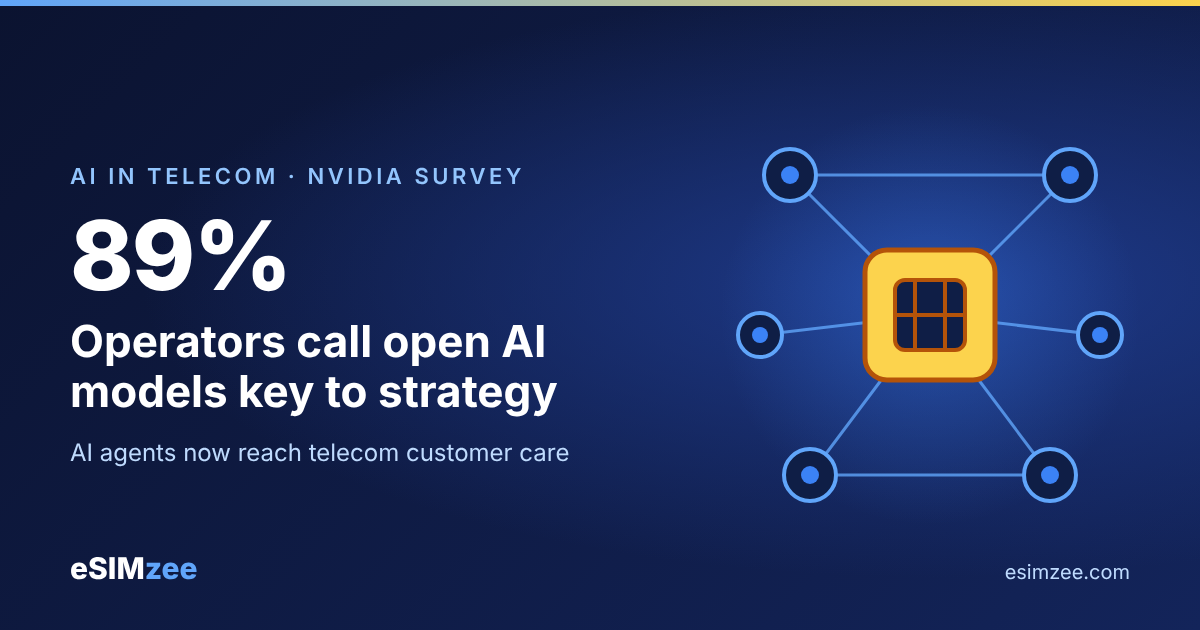
NVIDIA's latest State of AI in Telecommunications report found that 89% of respondents call open-source models and software important to their company's AI strategy. Open models publish their weights, so an operator can fine-tune them on its own data and run them on its own infrastructure.
NVIDIA lists five reasons: lower cost for frontier-level intelligence, telecom-specific customization, visibility into model behavior, flexible deployment, and the chance to host local-language AI for customers. It also announced Nemotron 3 Large Telco Model, a 30-billion-parameter model fine-tuned by AdaptKey on open telecom datasets. NVIDIA says it handles tasks such as network configuration and customer incident triage.
AT&T's chief data and AI officer Andy Markus said the future is about matching each workload to the right mix of performance, cost and control. SoftBank Corp. is building its own Large Telecom Model on open foundations, and Indosat Ooredoo Hutchison is building Sahabat-AI for Indonesian language and culture.
AI agents in customer care: what Parloa and Telus Digital are doing
Telus Digital will provide integration, change management and managed services for Parloa's AI agents, Mobile World Live reports. Businesses buy the platform directly from Parloa. The deal expands Parloa's delivery capacity in North America and Europe.
Parloa's agents handle authentication, bookings, payments and order enquiries, then pass the conversation to a human when personal help is needed. Mobile World Live says Parloa cited its own study of 10,000 enterprise websites and 4,000 chat interactions. It found fewer than 9% of chatbot conversations reached a resolution, and only about 10% of escalation attempts connected users with a person.
That is a vendor's research, so read it as Parloa's argument for its product. Telus Digital's Will Mayo framed the deal around cost: repetitive contact-centre volume raises the cost to serve without improving the experience.
How far autonomy has actually come
NVIDIA's own engineering blog says telco automation typically sits at Level 2-3 of the TM Forum autonomous networks scale. Reaching Level 4-5 requires agents that understand operator intent, sense the network in real time and coordinate governed actions across domains. That post, published June 22, 2026, says operators and partners are piloting autonomous agents for customer care. It gives no customer-care outcome figures.
The pattern is clear. Agents take routine requests today, and people keep the complicated ones.
What this means for travelers
Expect your next eSIM support chat to start with an AI agent. Routine questions, such as "has my plan activated?", will resolve fast. Anything unusual should reach a person, but Parloa's own figures show escalation is where many chatbots fail.
Prepare before you fly. Install your eSIM on Wi-Fi, keep the order email and activation details to hand, and pick a provider that publishes clear support options. Compare plans and providers on eSIMzee's provider pages before you buy.
Ask for a human early if the agent repeats itself twice. State your phone model, your destination and the exact error in your first message so the agent has what it needs.
Sources
- Why Telecom Operators Are Building Their AI Strategy on Open Models, NVIDIA Blog, October 6, 2026
- Telus Digital becomes integration partner for Parloa AI agents, Mobile World Live, October 14, 2026
- How Telcos Build Autonomous Networks with Agentic AI, NVIDIA Technical Blog, June 22, 2026